✅ How can UK small businesses reduce energy costs in 2026?
In order of speed-to-savings: fix the contract - businesses have no price cap, and out-of-contract or “deemed” rates routinely run far above negotiated ones, so diarise renewals and compare the whole market (broker commissions now disclosed); cut consumption - LED, controls, heating optimisation, with efficiency grants available locally and sector schemes for heavier users; generate and upgrade - solar, heat pumps and efficient plant funded through green asset finance, including guarantee-backed green lending, so savings pay for kit. Money Pilot arranges the funding layer - 200+ lenders, zero broker fees, FCA regulated (FRN: 968705).
Business energy costs reduction uk strategy has a correct order of operations, and most firms run it backwards. Energy remains one of the heaviest fixed costs UK SMEs carry - and unlike households, businesses have no price cap: the market charges exactly what your contract says, which makes the contract the first lever, targeted efficiency the second, and generation and green funding the compounding third. Here is the 2026 playbook in that order, including who actually pays for the kit.
Bank of England held base rate at 4.25% in June 2026 - waiting for inflation to cool.
73% of UK SMEs expect to grow in the next 12 months - confidence remains strong.
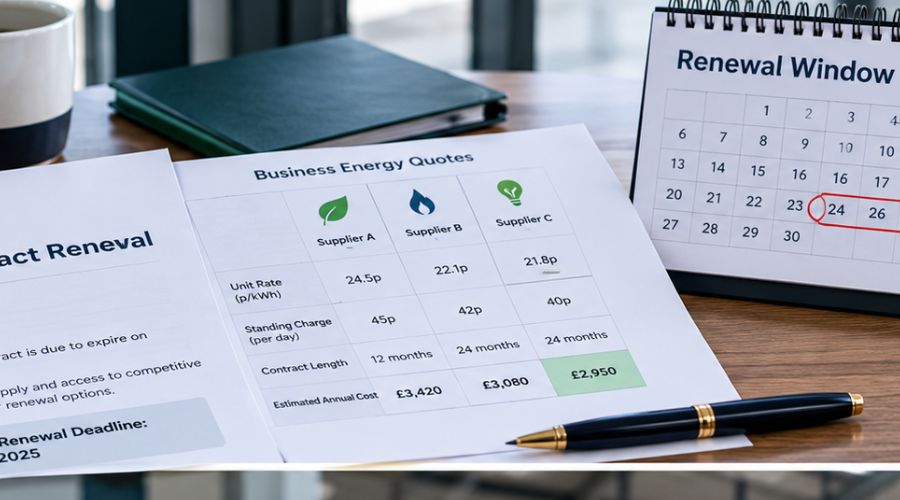
SME energy contract renewal tips UK - the cheapest kilowatt is a negotiated one
Sme energy contract renewal tips uk start from an unglamorous truth: more money is lost at renewal than anywhere else in business energy. The discipline:
- Never land on deemed or out-of-contract rates - the default tariffs applied when a contract lapses are the market’s most expensive electricity; diarise end dates and start comparing 4 - 6 months out
- Serve termination notice on time - some contracts still auto-rollover; the notice window is where suppliers quietly win
- Fix with intent, not habit - 12–36 month fixes buy certainty; compare against your appetite for market risk rather than defaulting to whatever the renewal letter offers
- Make brokers show their money - TPI commission disclosure is now the norm: ask the per-kWh uplift in writing, and compare a broker quote against at least one direct one
- Check the invoice plumbing - correct meter profiles, VAT treatment (5% for qualifying low usage), and Climate Change Levy lines: billing errors are a free audit away
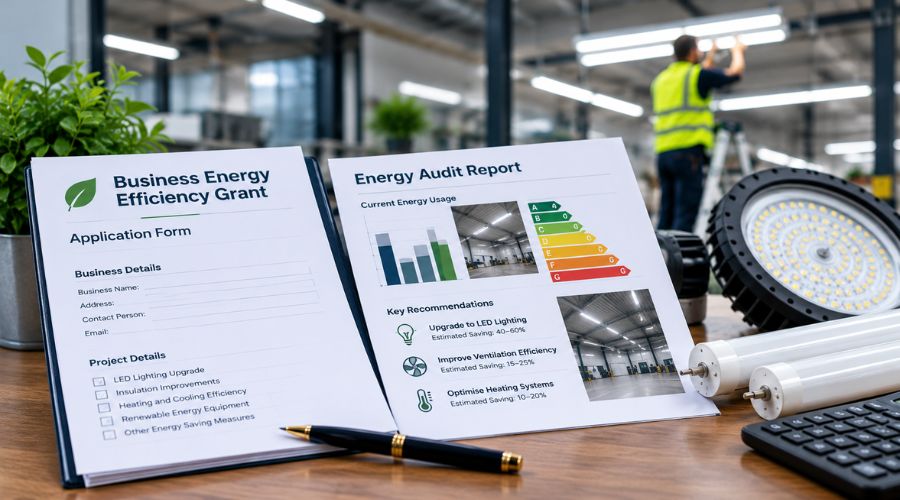
Energy efficiency grants business UK - who funds the kit you should buy anyway
Energy efficiency grants business uk hunting is fragmented but genuinely rewarding: much of the money sits locally — councils, Growth Hubs and regional net-zero programmes fund audits, LED swaps, insulation and controls for SMEs, frequently as 30–50% match-funded capital grants; sector and scale schemes - industrial users have dedicated transformation funding, and devolved nations run their own interest-free loan and grant programmes; and the audit comes first - most schemes want an energy assessment identifying measures, which doubles as your private business case: lighting and controls routinely pay back in 1–3 years before any grant touches them. The craft is stacking: audit → grant for what qualifies → green finance for the remainder - the same stacking logic your premises may soon need anyway under the MEES/EPC trajectory.
Green asset finance UK - making the savings buy the kit
Green asset finance uk is the quiet unlock: efficiency and generation assets fund beautifully on asset finance, because the energy saving services the repayment.
How the funding layer works:
- Solar PV on finance - commercial rooftop solar commonly pays back in roughly 4–7 years; structured on hire purchase or lease, monthly cost can sit at or below the bill saving from day one
- Heat pumps, LED retrofits, efficient plant - standard asset finance structures apply: HP where you’ll own long-term, leasing where kit cycles (the HP-vs-lease decision)
- Guarantee-backed green lending - the British Business Bank’s Growth Guarantee Scheme has piloted a green variant, improving terms for qualifying sustainability investments through accredited lenders
- Green tiers at mainstream lenders - a growing set price sustainability-linked facilities a notch keener; worth asking for by name
- The test - model saving vs repayment honestly: kit that cash-flows positive from month one is not an expense decision, it’s an arbitrage
The 2026 energy playbook - sequenced and financed
Run the levers in order: contract fixed on negotiated terms with the notice diary set; an energy audit converting guesswork into a ranked measure list; grants claimed where the postcode and sector allow; the remaining capex structured on green asset finance (the wider kit-funding context sits in our equipment finance guide); and the whole package re-reviewed at every renewal, because the market, the grants and the technology all move. Money Pilot arranges the finance layer - solar, plant, efficiency packages, guarantee-backed green facilities — across 200+ lenders at zero broker fees. Call 020 4634 8617 with last month’s bill and the kWh number; the savings case usually writes itself. FCA regulated (FRN: 968705).