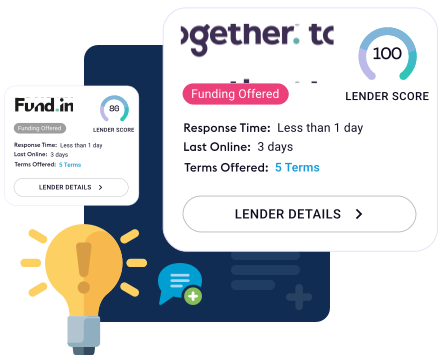
Access fast, short-term property funding with Money Pilot UK — connect instantly with all our available / applicable lenders. offering flexible bridging loans, competitive rates, and rapid approvals for confident property moves.
Bridging Loans with Money Pilot
£
Popular:
£
Speak to an ExpertWe're here to help
Fast Property Funding When Time Matters
Money Pilot helps buyers, landlords, and developers secure quick bridging loans to purchase, refinance, or complete property transactions.
We connect you with trusted UK lenders competing to fund your short-term goals.
Three simple steps to get you the funding you need, faster.
1
Submit Enquiry
Complete a fast but in-depth overview of your finance requirements to allow our powerful matching engine to source the right lenders for you.
2
Connect
Engage directly with lenders in real-time, with our friendly advisors always on hand to guide you through every step of the funding journey.
3
Apply
Track your enquiry in real-time and seamlessly move to application — all in one place — getting you to your funds faster and with less hassle.
Bridging finance is a short-term secured loan designed to “bridge the gap” between transactions, providing quick access to capital until long-term funding is arranged.
Short-term secured property loans
Ideal for auction purchases or fast completions
Suitable for residential or commercial assets
Flexible repayment options
UK-wide lender network
Money Pilot’s matching engine delivers instant lender options based on timeline, loan size, and property type.
At Money Pilot, we’ve reimagined bridging finance for time-critical property moves. Our system matches borrowers instantly with lenders who understand auction deadlines, chain breaks, and rapid completions.
From valuation to exit, we provide clear terms, fast decisions, and hands-on support so your deal never stalls.
It funds auction purchases, renovations, or property bridging before sale or refinance — ideal for short-term capital needs.
Most cases match within 24 hours; funds typically release in 7–10 working days after valuation and legals.
Yes — lenders offer bridging for residential, semi-commercial, and commercial properties UK-wide.
Yes — bridging is secured on property or land value so funds release faster with reduced lender risk.
No — Money Pilot is fully transparent with zero hidden charges and clear fee breakdown upfront.
Many partner lenders allow early repayment with minimal exit fees — terms depend on each lender’s policy.
The fastest UK bridging loans complete in 5 to 10 working days for straightforward cases. Most complete within 3 to 4 weeks. Speed depends on the complexity of the security, clarity of the exit strategy, and how quickly solicitors and valuers can act. Money Pilot identifies the lenders moving fastest at the time of your application.
Most UK bridging lenders offer up to 75% LTV for residential security and 65 to 70% for commercial property. Some specialist lenders will consider up to 80% where additional security is available. The best rates are typically at lower LTV positions. Money Pilot compares LTV appetite across 200+ specialist lenders.
Yes — specialist bridging lenders assess the security and exit strategy rather than credit history as the primary underwriting factor. Adverse credit including CCJs, defaults, and missed payments does not automatically preclude a bridging loan. The rate may be higher to reflect additional risk, but a well-structured case with strong security and a credible exit is fundable. Money Pilot identifies lenders with appetite for adverse credit cases.
Yes — bridging finance is the most common funding method for auction purchases in the UK. Auction conditions typically require completion within 28 days. Standard mortgages cannot meet this deadline; bridging lenders can. Money Pilot arranges an agreement in principle before the auction so you have funding confidence before bidding. Zero broker fees. FCA regulated (FRN: 968705).
A first charge bridging loan is secured as the only loan against the property — the lender has the primary legal charge. A second charge bridging loan sits behind an existing mortgage or loan on the same property — the bridging lender takes a second legal charge. Second charge bridging is used to raise capital from a property that already has a mortgage without disturbing the existing loan. Rates are typically slightly higher than first charge to reflect the additional risk.
Money Pilot compares bridging finance from 200+ specialist UK lenders — including MT Finance, Hope Capital, Octane Capital, West One Loans, and Tuscan Capital — matching your property, LTV, exit strategy, and timeline to the lender most suited to your case. Commercial bridging finance also available. Zero broker fees. FCA regulated (FRN: 968705). Call 020 4634 8617.
Usually no — bridging is asset-and-exit lending. The lender underwrites the property value and how you will repay (sale or refinance), not your monthly income.
A bridge secured on your own home is FCA-regulated; loans on investment or commercial property are unregulated products. Either way, arranging through Money Pilot puts a directly FCA-regulated broker (FRN: 968705) on your side.
Yes. A commercial bridging loan is secured against commercial or semi-commercial property and is used for purchases, refinances or works ahead of a commercial mortgage. We cover these through our commercial bridging finance service.
Most bridging lenders fund up to around 75 percent of the property value, so you contribute the balance as a deposit or as existing equity in the security property. Higher loan to value is possible with additional security.
✅ What is bridging finance and how does it work in the UK?
Bridging finance is a short-term secured loan that bridges the gap between a property purchase and a longer-term funding solution — completing in as few as 5 to 14 days. It is used for auction purchases, chain breaks, refurbishment, and unmortgageable properties. Money Pilot compares 200+ specialist UK bridging lenders — FCA regulated (FRN: 968705), zero broker fees.
How bridging finance works in the UK
Bridging finance is a secured short-term loan typically lasting 1 to 24 months. Unlike a mortgage, bridging finance is assessed primarily on the security - the property being used as collateral - and the exit strategy, rather than on income and employment status. This makes it accessible to a far wider range of borrowers than standard mortgage products.
Bank of England held base rate at 4.25% in June 2026 — waiting for inflation to cool.
73% of UK SMEs expect to grow in the next 12 months — confidence remains strong.
When UK property investors use bridging finance
Auction purchases - completing within the 28-day auction deadline is impossible with a standard mortgage; bridging lenders complete in 5 to 14 days
Chain breaks - purchase the new property immediately using a bridge, then repay from the proceeds of the existing property sale on your own timeline
Unmortgagable properties - properties in poor condition, without a functioning kitchen or bathroom, or with structural issues that mortgage lenders decline
Refurbishment and conversion - purchase and refurbish a property using a bridge, then refinance onto a buy-to-let mortgage or sell once works are complete
Bridging finance rates and terms in the UK
UK bridging finance rates typically range from 0.55% to 1.5% per month depending on the lender, LTV, and security. Terms range from 1 to 24 months. Interest can be rolled up (no monthly payments - repaid at exit), retained (deducted upfront), or serviced (paid monthly). Most lenders offer up to 75% LTV for residential bridging and 65% to 70% for commercial security.
Specialist bridging lenders use manual underwriting, assessing each case on the strength of the security and the credibility of the exit strategy rather than applying rigid automated criteria.
Key bridging lender assessment criteria:
Security value and LTV - the property value and the loan-to-value position are the primary underwriting factors
Exit strategy - sale of the property or refinance onto a mortgage must be credible and evidenced
Speed requirements - some lenders specialize in very fast completions; others are better suited to complex cases
Property type - residential, commercial, semi-commercial, land, and mixed use all attract different lender appetite
Borrower profile - adverse credit, self-employment, and complex income are all considered by specialist lenders
Bridging finance completes in 5 to 14 days — far faster than any mortgage. Money Pilot compares 200+ specialist UK bridging lenders at zero broker fees.
Bridging finance - four things every borrower must understand
Whether you are a first-time bridging borrower or an experienced property investor, these four elements determine whether your bridging loan will complete on time and on the terms you expect.
UK bridging loans are classified as either regulated or unregulated. A regulated bridging loan is secured on a property the borrower or a close family member currently lives in or intends to live in - governed by FCA rules and requiring appropriate advice. Unregulated bridging loans cover all other cases including investment properties, commercial property, development security, and land. Most property investor and developer bridging loans are unregulated. Money Pilot is FCA regulated (FRN: 968705) and can advise on both.
A closed bridging loan has a fixed repayment date - typically because contracts have been exchanged on a property sale that will provide the exit funds. A closed bridge carries less lender risk and typically attracts a lower rate. An open bridging loan has no fixed repayment date within the agreed term - the borrower repays when the exit event occurs. Open bridges are more flexible but typically slightly more expensive to reflect the additional lender risk.
Every bridging loan must have a clearly defined and credible exit strategy before a lender will commit. The two most common exits are sale of the property and refinance onto a long-term mortgage. For sale exits, agent valuations and comparable evidence strengthen the case. For refinance exits, a mortgage in principle from an appropriate lender before the bridge is taken is the most robust approach. Lenders assess exit credibility very carefully - a weak or speculative exit is the most common reason for declining.
A re-trade occurs when a bridging lender changes the terms of the loan - reducing the loan amount, increasing the rate, or adding conditions - close to the point of completion. Re-trades waste legal costs already incurred and can jeopardise purchase deadlines. Using a broker with strong lender relationships and current knowledge of which lenders have a reputation for delivering on original terms is the most effective way to avoid this risk. Money Pilot has direct relationships with all major specialist bridging lenders.
Bank of England held base rate at 4.25% in June 2026 — waiting for inflation to cool.
73% of UK SMEs expect to grow in the next 12 months — confidence remains strong.
Broker vs direct lender - why comparison wins on bridging
Most bridging results you will see are single lenders promoting their own book. A lender can only ever offer you their rate; a whole-of-market broker prices your case across every book at once - and on a product where quotes range from 0.55% to 1.5% per month, that spread is thousands of pounds on a six-month loan.
What matters
Typical direct / other brokers
Money Pilot
Rates you see
One lender's rate card
Every live rate across 200+ lenders, from 0.55% pm
Max LTV
Capped by one book
Best available for your asset and exit - up to 75% residential
Speed to funds
One lender's pace
Matched to the fastest lender your case fits - 5 to 14 days
Broker fee
1-1.5% where a broker is used
£0 - zero broker fees, always
Regulated advice
Varies; many unregulated intermediaries
Directly FCA regulated (FRN: 968705)
Packaging - the part of the deal you control
What separates outcomes at the same LTV is packaging: a case presented with a clean exit (sale evidence or a refinance decision in principle), title information and valuation access ready will beat an identical unpacked case on both rate and speed. That packaging is exactly what our team builds before any lender sees your file - it is how quiet cases get loud pricing.
The zero-fee promise
Most UK brokers charge 1- 1.5% of the loan as their fee - on a £500,000 bridge, that is £5,000-£7,500 before you have borrowed a penny. Money Pilot charges zero broker fees - we are paid by the lender, our whole-of-market comparison across 200+ specialist UK lenders stays free to you, and Miranda Khadr’s team is directly FCA regulated (FRN: 968705).
Bridging finance is short term property funding that bridges a gap between buying and a longer term exit. UK investors and businesses use it when speed matters more than the lower rate of a mortgage, for example to secure an auction purchase inside the 28 day deadline, to buy before an existing property sells, or to fund works that make a property mortgageable. A bridging loan is secured against property and usually runs from a few weeks up to 24 months, repaid either from a sale or by refinancing onto a mortgage.
As a whole of market bridging loan broker in the UK, Money Pilot arranges both regulated and unregulated bridging, from single residential units to commercial bridging loan cases, and matches the case to the lender most likely to say yes at the best rate.
How bridging loans work
A bridging loan is arranged against the value of the property offered as security, with the lender taking either a first charge or a second charge. Interest is normally rolled up or retained rather than paid monthly, so there is nothing to service during the term, and the full amount is cleared on exit. The three things every lender assesses are the security, the exit, and the borrower experience.
Stage
What happens
Typical timescale
Enquiry and terms
We assess the case and issue indicative terms
Same day
Valuation
Lender instructs a surveyor on the security
3 to 7 days
Legals
Solicitors handle searches and the charge
1 to 2 weeks
Completion
Funds released, interest retained or rolled up
2 to 3 weeks total
For a full worked example of what a bridging loan costs, including monthly rate, arrangement fee and exit, see our guide on how much a bridging loan costs. For current pricing see our guide to typical UK bridging loan rates.
Bridging loan requirements in the UK
Lenders care less about income and more about the asset and the exit. The core requirements are a viable property as security, a clear and realistic exit, and a deposit or existing equity, usually giving a loan to value up to around 75 percent. Adverse credit is often acceptable where the exit is strong. A credible exit is the single most important factor, because it is how the loan gets repaid.
Money Pilot is directly authorised and regulated by the Financial Conduct Authority, firm reference number 968705, and advises under Consumer Duty, so the recommendation is based on the whole market rather than one lender panel.
Unit 1, Verney House 1B Hollywood Road, London SW10 9HS
Opening Times: 9am - 6pm, Mon - Fri
Company Registration No. 13621432
We use cookies to improve your experience, provide live support, and analyse site traffic. By clicking "Accept All", you consent to our use of cookies.
Cookie Preferences
Select which cookies you want to accept. Essential cookies cannot be disabled.
Required for the website to function securely and save your preferences.
Enables our live chat support (HubSpot) and remembers your session state.
Allows us to measure traffic and see how visitors use the site via Google Analytics.
Used to deliver and track personalized advertisements via Google Ads and Meta.