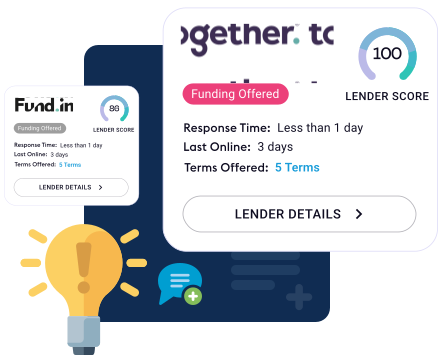
Unlock cash tied in unpaid invoices with Money Pilot UK - accelerate working capital, improve cash flow, and grow with flexible invoice finance by comparing all our available and applicable lenders.
Invoice Finance with Money Pilot
£
Popular:
Speak to an ExpertWe're here to help
Cash Flow Without the Wait
Money Pilot enables UK businesses to release up to 90% of invoice value within 24 hours.
We match you to lenders offering flexible, transparent invoice discounting and factoring solutions.
We help UK businesses unlock working capital from unpaid invoices—fast and transparently. Money Pilot matches you to factoring or discounting options, clarifies fees, and coordinates onboarding.
With the right facility, cash flow strengthens while customer relationships stay intact.
A funding solution allowing businesses to receive cash advances against unpaid invoices.
Any business issuing invoices to other businesses on credit terms.
Usually up to 90% of invoice value.
Yes — both disclosed and confidential options available.
All fees will be disclosed before any application is made.
Invoice finance providers typically require a minimum annual turnover of £100,000 to £250,000 for whole-ledger facilities. Some specialist providers will consider smaller businesses with lower turnover, particularly for selective invoice finance where individual invoices are funded rather than the whole ledger. The right provider and facility structure depend on your turnover level, invoice values, and customer profile. Money Pilot identifies the most appropriate provider for your specific business size.
Invoice factoring (disclosed) means your customers are aware that a third party is managing collections — which some businesses are concerned about. Invoice discounting (confidential) keeps the arrangement invisible to your customers, with collections managed in your own name. For businesses where customer relationships are sensitive to third-party involvement, confidential invoice discounting is the appropriate structure. A specialist broker identifies the right structure before approaching providers.
Most invoice finance providers advance up to 80 to 90% of the approved invoice value immediately. The remaining 10 to 20% is held as a reserve and released once the customer pays the full invoice amount, less the provider's charges. The advance rate depends on the quality of the debtor book, the concentration of individual customers, and the provider's assessment of credit risk. Higher-quality debtor books with creditworthy customers attract higher advance rates.
Yes — invoice finance is compatible with most other business finance products. It can be used alongside business loans, asset finance, and commercial mortgages. Some invoice finance providers do require that any existing overdraft secured on the business's debtors is cleared before the invoice finance facility is established, as the debtor book is the primary security for the invoice finance arrangement. A specialist broker structures the overall finance package to ensure all facilities work together correctly.
Most invoice finance facilities can be set up within 1 to 3 weeks from initial enquiry to first drawdown. The process involves the provider conducting due diligence on the business, its customers, and its outstanding invoices, followed by legal documentation and facility setup. Once established, subsequent drawdowns can be made within 24 hours of submitting an invoice. A specialist broker who understands each provider's onboarding process can significantly compress the setup timeline.
Money Pilot compares invoice finance providers across the full UK market including Bibby Financial Services, Aldermore Invoice Finance, Lloyds Bank Commercial Finance, and specialist independent providers — matching your business size, turnover, customer profile, and facility preference to the right provider. We also compare supply chain finance and other working capital solutions. Zero broker fees. FCA regulated (FRN: 968705). Call 020 4634 8617.
✅ What is invoice finance and how does it work for UK businesses?
Invoice finance allows UK businesses to release up to 90% of the value of outstanding B2B invoices within 24 hours rather than waiting 30, 60, or 90 days for customers to pay. A specialist finance provider advances the funds against approved invoices and collects payment from the customer on the original due date. Money Pilot compares invoice finance from specialist UK providers - FCA regulated (FRN: 968705), zero broker fees.
How invoice finance works for UK businesses
Invoice finance converts outstanding B2B invoices into immediate working capital - solving the cash flow problem that arises when businesses have to wait for customers to pay on 30, 60, or 90 day terms. It is particularly valuable for growing businesses where the gap between issuing invoices and receiving payment creates a working capital strain that limits growth.
Bank of England held base rate at 4.25% in June 2026 - waiting for inflation to cool.
73% of UK SMEs expect to grow in the next 12 months - confidence remains strong.
Invoice factoring versus invoice discounting
The two main types of invoice finance differ primarily in who manages collections from the customer:
Invoice factoring (disclosed) - the finance provider manages the sales ledger and collects payment directly from the customer in the provider's name. The customer is aware that their invoice has been sold to a third party. Most suitable for smaller businesses that do not have a dedicated credit control function
Invoice discounting (confidential) - the business retains control of its sales ledger and continues to collect payment from customers in its own name. The finance arrangement is not disclosed to customers. Most suitable for larger, more established businesses with their own credit control function
Selective invoice finance - the business chooses which individual invoices to finance rather than the whole ledger. More flexible but typically more expensive per invoice than whole-ledger facilities
How much does invoice finance cost?
Invoice finance costs consist of two elements - a service fee (typically 0.2 to 2% of annual turnover) covering ledger management and credit control, and a discount charge (typically 1.5 to 3.5% above base rate) applied to the funds advanced. The total cost compares favorably to the cost of an overdraft when the improved cash flow and removal of credit risk are factored in. Money Pilot compares invoice finance providers alongside supply chain finance at zero broker fees. FCA regulated (FRN: 968705).
What invoice finance providers assess
Invoice finance providers assess the quality of the business's debtor book - the customers and invoices that will be used as security - as much as the business itself. Understanding what they assess helps you identify the most suitable facility structure.
Key invoice finance assessment criteria:
Customer quality - the creditworthiness of the business's customers is the primary security; strong, creditworthy customers support higher advance rates
Invoice values and volumes - minimum turnover requirements vary by provider; some focus on high-volume lower-value invoices, others on fewer larger invoices
Debtor concentration - providers are cautious about high concentration in a single customer; typically limit any single debtor to 20–25% of the ledger
Payment terms and debtor days - standard 30 to 90 day terms are most suitable; very short or very long payment terms require specialist providers
Business type - B2B businesses only; B2C businesses are generally not eligible for invoice finance
Invoice finance releases up to 90% of outstanding B2B invoice value within 24 hours — converting your debtor book into immediate working capital. Compare specialist providers at Money Pilot.
Invoice finance - four situations where it transforms business cash flow
These four business situations show where invoice finance delivers the greatest cash flow benefit and why it is often more appropriate than a business loan or overdraft for B2B businesses.
Fast-growing businesses frequently encounter a cash flow problem where the cost of delivering orders — paying staff, suppliers, and overheads — falls due before customers pay their invoices. The faster the growth, the larger the gap between cash out and cash in. Invoice finance grows automatically with the business — as turnover increases, more invoices are raised, and more working capital becomes available through the facility. Unlike a fixed overdraft or business loan, invoice finance scales with revenue without requiring a new application each time the business wins a large contract.
Businesses with strong seasonal peaks — construction, hospitality, retail, and agriculture — face periods where cash outflows significantly exceed inflows before the seasonal revenue arrives. Invoice finance provides working capital through the lean period by advancing cash against invoices already raised, bridging the gap between issuing invoices and receiving payment. This allows the business to meet payroll, pay suppliers, and maintain operations during the seasonal trough without drawing on reserves or taking on additional debt.
Winning a large new contract is good news for a business but often creates an immediate working capital challenge — the business must invest in staff, materials, and equipment to deliver the contract before the customer pays. Invoice finance allows the business to draw down against the invoices raised during contract delivery, funding the ongoing costs of the contract from the invoices it generates rather than from reserves or additional borrowing. This makes large contracts fundable without straining the business's working capital.
Many invoice finance facilities include optional bad debt protection — insurance that pays out if an approved customer becomes insolvent and cannot pay their invoice. This removes the credit risk associated with extending payment terms to customers, which is particularly valuable where the business relies on a small number of large customers. Bad debt protection turns the invoice finance facility into both a cash flow and a risk management tool, allowing businesses to trade confidently with customers of all sizes without the fear of a single bad debt threatening the business.
Bank of England held base rate at 4.25% in June 2026 - waiting for inflation to cool.
73% of UK SMEs expect to grow in the next 12 months - confidence remains strong.
Headline rates vs the all-in cost - reading invoice finance pricing
Invoice finance adverts quote one number; facilities charge two. The service fee (a % of turnover) and the discount fee (interest on funds drawn) only mean anything combined, on your ledger, at your drawing pattern - which is the comparison headline rates are designed to avoid.
What matters
Advertised headline offers
Money Pilot
What's quoted
'From 0.1%' - one fee of the two, on the largest ledgers
Both fees, combined, on your actual turnover
True SME cost
Discovered after signing
Typically 1–3% of funded turnover - shown before you choose
Facility match
The advertiser's product
Factoring, confidential discounting or selective - whichever fits
Contract terms
Long lock-ins common
Notice periods and minimums compared across 200+ funders
Broker fee
Often built into pricing
£0 - zero broker fees
The three-number comparison that protects you
Before signing any facility, put three numbers side by side for each offer: the service fee applied to your annual turnover, the discount fee applied to your realistic average drawings, and the extras (minimum fees, credit checks, same-day payment charges, renewal fees). The total, divided by funded turnover, is your true annual percentage cost - and it re-orders the league table of offers almost every time.
Two contract terms matter as much as price: the notice period (12-month lock-ins with 3-month notice are common; shorter exists) and the minimum fee (a floor you pay even in quiet months). We run this three-number comparison across every competing funder and show you the ranked result before you commit - that transparency is the product.
The zero-fee promise
Most UK brokers charge 1–1.5% of the loan as their fee. Money Pilot charges zero broker fees - we are paid by the lender, our whole-of-market comparison across 200+ specialist UK lenders stays free to you, and Miranda Khadr’s team is directly FCA regulated (FRN: 968705).
Unit 1, Verney House 1B Hollywood Road, London SW10 9HS
Opening Times: 9am - 6pm, Mon - Fri
Company Registration No. 13621432
We use cookies to improve your experience, provide live support, and analyse site traffic. By clicking "Accept All", you consent to our use of cookies.
Cookie Preferences
Select which cookies you want to accept. Essential cookies cannot be disabled.
Required for the website to function securely and save your preferences.
Enables our live chat support (HubSpot) and remembers your session state.
Allows us to measure traffic and see how visitors use the site via Google Analytics.
Used to deliver and track personalized advertisements via Google Ads and Meta.