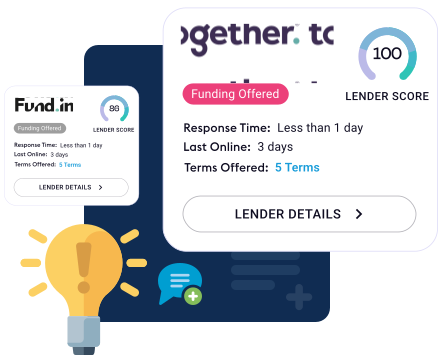
Money Pilot pairs businesses with flexible overdraft providers that stabilise cash flow, not complicate it. We clarify pricing and limits, accelerate approvals, and keep terms transparent.
You get a reliable safety net that responds to seasonality and growth.
A flexible borrowing facility for temporary cash-flow gaps.
SMEs, traders, and limited companies with UK bank accounts.
Interest applies only on the amount used within the limit.
Variable — depend on lender and facility size.
No hidden fees — Money Pilot is completely transparent.
Often same-day once bank details and turnover are verified.
A business overdraft is a feature of the business's bank current account — the bank permits the account to go negative up to an agreed limit. It is typically an uncommitted facility that can be reduced or withdrawn at the bank's discretion. A revolving credit facility is a separate, committed lending product from a specialist provider — the business draws funds into its account when needed and repays them when cash flow allows. Revolving credit facilities are more stable, often more competitive, and cannot be withdrawn at short notice during the agreed term.
Business overdraft and revolving credit facility limits range from £5,000 for small businesses up to £5 million or more for larger SMEs. The limit is typically set as a multiple of average monthly turnover — most providers offer between 1 and 3 months' average revenue as the maximum facility size. Some invoice-backed facilities grow automatically as the business's debtor book grows. Money Pilot identifies the provider offering the highest limit for your specific business profile and turnover level.
Yes — specialist revolving credit facility providers assess the business's bank statement performance and revenue consistency as primary underwriting criteria, with credit history as one factor among several. A business that demonstrates consistent monthly revenue and responsible bank account management can access a credit facility even with historical adverse credit. The rate will be higher to reflect the additional risk. Money Pilot identifies specialist providers with appetite for adverse credit business credit facility applications.
Specialist revolving credit facility providers typically provide an in-principle decision within 24 hours of receiving bank statements and can activate the facility within 48 to 72 hours of approval. Bank overdrafts take longer to arrange through the business's existing bank, often requiring a branch appointment and several days of processing. For businesses needing immediate flexible access to working capital, specialist providers are typically faster than the business's own bank.
Revolving credit facility costs consist of two elements — a facility fee (typically 1 to 3% per annum of the total facility limit, charged whether or not the facility is used) and a draw-down rate (typically 6 to 20% per annum, charged only on the amount drawn at any time). Some providers charge only on drawn amounts with no facility fee. The total cost for a business that draws the full facility for 6 months and repays is significantly lower than an equivalent fixed-term loan at the same rate because the interest is only charged during the drawn period.
Money Pilot compares business overdraft alternatives and revolving credit facilities from specialist UK providers — matching your monthly turnover, cash flow profile, and credit history to the most appropriate facility and provider. We also compare invoice finance for B2B businesses and short term business loans for larger one-off requirements. Zero broker fees. FCA regulated (FRN: 968705). Call 020 4634 8617.
✅ What is a business overdraft and how do credit facilities work for UK businesses?
A business overdraft is a flexible credit facility attached to a business current account, allowing the business to draw funds beyond its available balance up to an agreed limit. Interest is charged only on the amount overdrawn at any time. Business credit facilities also include revolving credit lines, which operate similarly but independently of the main bank account. Money Pilot compares business overdraft and credit facilities from specialist UK providers - FCA regulated (FRN: 968705), zero broker fees.
How business overdrafts and credit facilities work in the UK
Business overdrafts and revolving credit facilities are the most flexible forms of business finance available - draw down when needed, repay when cash flow allows, and redraw again without a new application. Unlike a fixed-term business loan, a credit facility does not require the business to commit to a fixed repayment schedule, making it ideal for managing variable and unpredictable cash flow requirements.
Bank of England held base rate at 4.25% in June 2026 - waiting for inflation to cool.
73% of UK SMEs expect to grow in the next 12 months - confidence remains strong.
Business overdraft versus revolving credit facility
Business overdraft - arranged through the business's bank as an extension of the current account. The business can go into a negative balance up to the agreed overdraft limit. Interest is calculated daily on the overdrawn balance. Typically reviewed annually and can be withdrawn by the bank at short notice
Revolving credit facility - a standalone facility from a specialist lender, independent of the business's main bank account. Funds are drawn into the business account when needed and repaid when not required. More stable than an overdraft - the facility is committed for an agreed term and cannot be withdrawn at short notice by the lender
Invoice-backed credit facility - a revolving facility secured against the business's outstanding invoices, growing automatically as the business issues more invoices. The most capital-efficient form of flexible credit for B2B businesses with regular invoicing. See invoice finance for details
Money Pilot compares business overdraft alternatives and revolving credit facilities from specialist UK lenders at zero broker fees. FCA regulated (FRN: 968705).
BLOCK 3
Split Block - Left Text + Right Image
Instructions: THIRD Text Block. CSS embedded. Upload image and confirm src path.
What business credit facility providers assess
Business overdraft and credit facility providers assess the business's cash flow management, trading performance, and ability to manage a revolving credit obligation responsibly. Understanding their criteria helps you apply to the right provider and secure the largest available limit.
Key assessment criteria for business credit facilities:
Average monthly bank balance - the primary indicator of cash flow management; consistent positive balances with occasional dips support larger limits
Monthly revenue and turnover consistency - stable, predictable monthly revenue supports the most competitive credit facility terms
Credit history - both business and personal credit profiles assessed; adverse credit is considered by specialist lenders
Business trading history - minimum 6 - 12 months typically required; some specialist providers consider earlier-stage businesses
Business overdraft and revolving credit facilities provide flexible working capital - draw when needed, repay when cash allows, redraw again. Interest charged only on the amount used at any time.
Business overdraft and credit facilities - four scenarios where flexibility beats a fixed loan
These four business situations show where a revolving credit facility or overdraft alternative delivers better outcomes than a fixed-term business loan, and why access to flexible credit is a core component of sound SME financial management.
The most common use case for a business credit facility is bridging the gap between paying suppliers and receiving customer payment. A business that pays suppliers on 30-day terms but offers customers 60-day payment terms has a 30-day working capital gap every month. A revolving credit facility bridges this gap automatically — drawn when needed to pay suppliers and repaid when customers settle their invoices. Unlike a fixed loan, the facility scales with the business's trading volume and costs nothing when not in use.
Every business faces unexpected costs — a piece of equipment breaks down, a key supplier requires early payment, or an insurance excess becomes due unexpectedly. Without a credit facility in place, the business must either dip into cash reserves intended for other purposes or delay paying other commitments. A revolving credit facility provides instant access to funds for unexpected costs without a new application, keeping operations running smoothly and cash reserves intact for planned purposes.
Seasonal businesses — hospitality, construction, retail, and agriculture — face periods where costs are high but revenue has not yet arrived. A revolving credit facility or business overdraft funds the cost of preparing for the seasonal peak — stocking up, hiring seasonal staff, and meeting supplier commitments — and is repaid from the seasonal revenue when it arrives. The facility costs nothing outside the peak period and does not require a new application each season.
Many UK SMEs rely on their bank overdraft as a default working capital tool — often at rates of 15% to 25% EAR and with the risk that the bank can withdraw the facility with limited notice. Specialist revolving credit facility providers offer committed facilities at more competitive rates, with greater certainty of availability and without the bank's ability to withdraw the facility at short notice. Money Pilot compares specialist revolving credit facilities alongside invoice finance and short term business finance options.
Bank of England held base rate at 4.25% in June 2026 - waiting for inflation to cool.
73% of UK SMEs expect to grow in the next 12 months - confidence remains strong.
Overdraft vs revolving credit facility - the honest comparison
Banks have spent a decade withdrawing and shrinking business overdrafts. The revolving credit facility does the same job - draw, repay, redraw, interest only on funds out - with one structural difference that changes everything: the limit is contractually committed.
What matters
Bank overdraft
Money Pilot
Can it be pulled?
Repayable on demand - limit cut at any review
Committed for the term; cannot be withdrawn early without cause
Typical pricing
4–8% over base, plus fees
Competitive committed pricing across 200+ lenders
Limit growth
Shrinks at reviews
Grows on clean conduct - touch-zero months are repricing evidence
Tied to your bank?
Yes - one bank's appetite
No - independent of where you bank
Speed to arrange
Weeks, relationship-dependent
Days: approved on bank statements, live in 1–2 weeks
The day-one switch - and running the facility well
The transition is mechanically simple: the new facility's first drawdown repays the overdraft, and from that morning your working capital runs through a committed line instead of a discretionary one. The timing rule matters more than the mechanics: arrange the replacement while the overdraft still exists - lenders price a calm switch better than a rescue, and your bank's next review stops being a threat.
Running it well compounds: draw for genuine gaps, clear to zero when cash allows, and keep the conduct record clean - committed facilities reprice and grow on evidence, and eighteen months of disciplined usage routinely earns a larger limit at a finer margin. Pair the RCF with a card programme for the everyday layer and the overdraft becomes something you simply never think about again.
The zero-fee promise
Most UK brokers charge 1 - 1.5% of the loan as their fee. Money Pilot charges zero broker fees - we are paid by the lender, our whole-of-market comparison across 200+ specialist UK lenders stays free to you, and Miranda Khadr’s team is directly FCA regulated (FRN: 968705).
Unit 1, Verney House 1B Hollywood Road, London SW10 9HS
Opening Times: 9am - 6pm, Mon - Fri
Company Registration No. 13621432
We use cookies to improve your experience, provide live support, and analyse site traffic. By clicking "Accept All", you consent to our use of cookies.
Cookie Preferences
Select which cookies you want to accept. Essential cookies cannot be disabled.
Required for the website to function securely and save your preferences.
Enables our live chat support (HubSpot) and remembers your session state.
Allows us to measure traffic and see how visitors use the site via Google Analytics.
Used to deliver and track personalized advertisements via Google Ads and Meta.