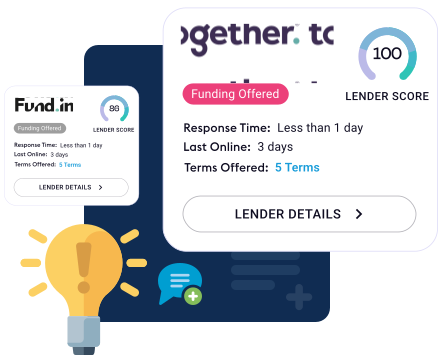
At Money Pilot, we redefine commercial bridging for UK businesses that value speed and clarity. Our system matches borrowers instantly with lenders who understand time-sensitive funding.
From start to completion, we provide end-to-end support, transparent terms, and quick decisions—turning opportunities into action.
A short-term loan secured on commercial property for purchases or refurbishments.
Typically approvals occur within 7 to 10 working days, depending on project size and lender criteria. Completion timelines may vary based on documentation and lender processing.
Commercial property or land serves as loan collateral.
Most lenders offer flexible early-repayment options with minimal fees.
Usually 0.8%–1.2% per month depending on LTV and risk.
No hidden fees. Money Pilot operates with full transparency for all bridging clients.
Most UK commercial bridging lenders offer a maximum LTV of 65 to 70% for standard commercial security such as offices, retail units, warehouses, and industrial premises. Semi-commercial properties (residential above commercial) may attract slightly higher LTVs with some specialist lenders. Land without planning permission typically attracts lower LTVs of 50 to 60%. The best rates are available at lower LTV positions. Money Pilot compares LTV appetite across the full specialist commercial bridging lender panel.
Specialist commercial bridging lenders accept a wide range of commercial property as security including offices, retail units, restaurants and hospitality venues, warehouses, industrial units, mixed-use properties, and land with or without planning permission. Some property types attract a more restricted lender panel — petrol stations, care homes, and specialist leisure properties for example. Money Pilot identifies the lenders with the right appetite for your specific property type.
Straightforward commercial bridging cases with a clean title, a standard property type, and a clear exit strategy can complete in 5 to 14 working days. More complex cases involving unusual property types, multiple titles, or complex borrower structures take 3 to 6 weeks. A broker with strong lender relationships and knowledge of each lender's current processing speed identifies the fastest option for your specific case.
Yes — specialist commercial bridging lenders focus primarily on the security value and exit strategy rather than the borrower's credit history. Adverse credit including CCJs, defaults, and previous insolvency does not automatically preclude a commercial bridge. The LTV may be lower and the rate higher to reflect the additional risk, but a well-structured case with strong security and a credible exit is fundable. Money Pilot identifies lenders with appetite for adverse credit commercial cases.
The two primary exits for commercial bridging finance are sale of the commercial asset and refinance onto a long-term commercial mortgage. For sale exits, agent valuations and comparable evidence of sold prices strengthen the case. For refinance exits, a mortgage in principle from a suitable long-term lender before the bridge completes is the most robust approach. Lenders assess the credibility of each exit individually — a forward sale or pre-let is viewed most favourably.
Money Pilot compares commercial bridging finance from 200+ specialist UK lenders — matching your commercial property type, LTV, exit strategy, and timeline to the lender most suited to your case. We also arrange long-term commercial mortgages and commercial property finance for the refinance exit. Zero broker fees. FCA regulated (FRN: 968705). Call 020 4634 8617.
✅ What is commercial bridging finance and how does it work in the UK?
Commercial bridging finance is a short-term secured loan used to fund time-critical commercial property transactions - including auction purchases, refurbishments, chain breaks, and refinancing where a conventional commercial mortgage cannot complete in time. Funds are typically released in 5 to 14 days. Money Pilot compares commercial bridging finance from 200+ specialist UK lenders - FCA regulated (FRN: 968705), zero broker fees.
How commercial bridging finance works in the UK
Commercial bridging finance operates on the same fundamental principles as residential bridging - a short-term secured loan with a defined exit strategy - but is used specifically for commercial, semi-commercial, and mixed-use properties. The lender assesses the commercial security value, the strength of the exit, and the borrower's experience rather than applying standard residential mortgage criteria.
Bank of England held base rate at 4.25% in June 2026 — waiting for inflation to cool.
73% of UK SMEs expect to grow in the next 12 months — confidence remains strong.
When commercial bridging finance is the right solution
Auction purchases of commercial property - the 28-day completion deadline cannot be met by a standard commercial mortgage; commercial bridging lenders complete in 5 to 14 days
Commercial refurbishment - purchasing a commercial property requiring significant works before a long-term mortgage lender will consider it
Preventing a commercial deal from collapsing - where a long-term lender is taking too long to complete and the transaction is at risk
Unmortgageable commercial assets - properties with vacant possession, short leases, structural issues, or planning complications that long-term lenders decline
Commercial bridging finance rates and terms
Commercial bridging rates typically range from 0.65% to 1.5% per month, with terms of 3 to 24 months. LTV is typically capped at 65 to 70% for commercial security. Interest can be rolled up, retained, or serviced depending on the lender and the borrower's cash flow position. Money Pilot compares bridging finance and commercial property finance at zero broker fees. FCA regulated (FRN: 968705).
What commercial bridging lenders assess
Commercial bridging lenders use manual underwriting, assessing each case individually. The primary focus is on the security value, the exit strategy, and the borrower's commercial property experience - not on income or employment status.
Key commercial bridging assessment criteria:
Commercial security value - the market value of the commercial property used as collateral, assessed by a specialist commercial valuer
LTV position - most lenders cap commercial bridging at 65–70% LTV; lower LTV positions attract better rates
Exit strategy - sale of the asset or refinance onto a long-term commercial mortgage must be credible and evidenced
Property type - offices, retail, industrial, warehouses, semi-commercial, and land all attract different lender appetite
Borrower experience - commercial property experience is viewed more favourably but adverse credit and complex profiles are considered
Commercial bridging finance completes in 5 to 14 days - far faster than a commercial mortgage. Compare 200+ specialist UK commercial bridging lenders at Money Pilot, zero broker fees.
Commercial bridging finance - four key scenarios explained
These four scenarios cover the most common situations where commercial bridging finance is the right solution for UK property investors and business owners.
Commercial property auctions offer significant buying opportunities, but the standard 28-day completion condition makes them inaccessible without bridging finance. A specialist commercial bridging lender can complete in 5 to 14 days for straightforward cases — well within the auction deadline. Money Pilot arranges an agreement in principle before the auction date so you have funding confidence before bidding. The bridge is then repaid from either a sale or a long-term commercial mortgage once the asset is stabilised.
Many commercial properties are in a condition that long-term mortgage lenders will not accept — vacant premises, properties requiring significant capital expenditure, or assets with planning complications. A commercial bridging loan funds the purchase and the refurbishment works. Once the works are complete and the property is either let or sold, the bridge is repaid through refinancing onto a long-term commercial mortgage or from sale proceeds. This strategy unlocks commercial property value that banks routinely decline.
Where a commercial property investor is selling an asset to fund a new purchase but the sale is delayed, a commercial bridging loan allows the new purchase to complete on time. The bridge is repaid from the proceeds of the existing sale once it completes. This avoids losing deposits, losing the new purchase, or having to renegotiate purchase terms — all of which carry significant cost and reputational risk in commercial transactions.
Long-term commercial mortgage lenders decline a wide range of assets that specialist commercial bridging lenders will fund — including vacant commercial property, short-lease assets (below 70 years for leasehold), properties with planning issues, mixed-use properties with complex income profiles, and commercial assets in poor structural condition. A commercial bridge allows the investor to purchase, address the specific issue that was causing the mortgage decline, and then refinance onto a long-term facility once the asset meets standard criteria.
Bank of England held base rate at 4.25% in June 2026 - waiting for inflation to cool.
73% of UK SMEs expect to grow in the next 12 months - confidence remains strong.
Commercial vs residential bridging - what actually changes
Commercial bridging runs on the same engine as residential - asset plus exit - but the commercial version changes the numbers and the underwrite in ways that catch borrowers out. Knowing the differences before you apply is what keeps the quote close to the completion.
What matters
Residential bridging assumptions
Money Pilot
Typical max LTV
Up to 75% residential
65–70% on commercial security - lower ceilings, priced accordingly
Valuation
Comparable sales, quick to evidence
Specialist commercial valuer; investment value and marketing-period assumptions matter
Exit timelines
Residential sales and remortgages move fast
Commercial sales run 6-12 months; refinance underwrites lean on leases or trading — build the term around it
Lender panel
Widest bridging market
A distinct commercial-appetite panel - matched by property type
Broker fee
1-1.5% common either way
£0 - zero broker fees, FCA regulated (FRN: 968705)
The exit decides the price - building a commercial exit that underwrites
Commercial bridging is priced off the exit more than anything else, and commercial exits are slower and lumpier than residential ones. A sale exit needs honest marketing-period assumptions - commercial disposals routinely run 6–12 months, which is why the valuer's 90-day and 180-day figures matter as much as the headline value. A refinance exit onto a commercial mortgage needs the future lender's underwrite visible today: a lease with real term and covenant for investment deals, or trading accounts that service the debt for owner-occupiers.
The strongest applications arrive with the exit pre-evidenced: an agent's marketing appraisal or a refinance decision in principle, alongside title and access for the valuer. That package moves both the rate and the LTV a lender will offer - and it is exactly what we assemble before your case goes to the panel. Sized right (realistic exit months plus buffer) and evidenced up front, commercial bridging does what it says: turns a deadline into a completed transaction.
The zero-fee promise
Most UK brokers charge 1–1.5% of the loan as their fee. Money Pilot charges zero broker fees - we are paid by the lender, our whole-of-market comparison across 200+ specialist UK lenders stays free to you, and Miranda Khadr’s team is directly FCA regulated (FRN: 968705).
Unit 1, Verney House 1B Hollywood Road, London SW10 9HS
Opening Times: 9am - 6pm, Mon - Fri
Company Registration No. 13621432
We use cookies to improve your experience, provide live support, and analyse site traffic. By clicking "Accept All", you consent to our use of cookies.
Cookie Preferences
Select which cookies you want to accept. Essential cookies cannot be disabled.
Required for the website to function securely and save your preferences.
Enables our live chat support (HubSpot) and remembers your session state.
Allows us to measure traffic and see how visitors use the site via Google Analytics.
Used to deliver and track personalized advertisements via Google Ads and Meta.