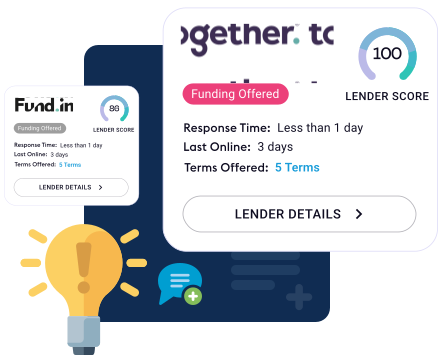
Money Pilot connects buyers and suppliers through digital funding that benefits both sides.
We work with all our available and applicable lenders to deliver instant solutions., efficient trade payments.
Complete a fast but in-depth overview of your finance requirements to allow our powerful matching engine to source the right lenders for you.
Engage directly with lenders in real-time, with our friendly advisors always on hand to guide you through every step of the funding journey.
Track your enquiry in real-time and seamlessly move to application— all in one place—getting you to your funds faster and with less hassle.
We align buyers and suppliers with programs that release trapped working capital on both sides. Money Pilot brings the right funders, clear pricing, and a smooth onboarding flow.
With trust and transparency, your supply chain becomes more resilient and liquid.
Access rapid, flexible funding solutions tailored for immediate business needs and cash flow management:
✅ What is supply chain finance and how does it work for UK businesses?
Supply chain finance is a specialist funding structure that allows buyers to extend their payment terms to suppliers while enabling those suppliers to receive early payment through a finance provider. The finance provider pays the supplier early at a small discount; the buyer repays the finance provider on the extended payment date. Both parties benefit — the supplier improves cash flow and the buyer preserves working capital. Money Pilot compares specialist supply chain finance lenders — FCA regulated (FRN: 968705), zero broker fees.
Supply chain finance — also known as reverse factoring or approved payables finance — is structured around the buyer's approved invoices. When a supplier issues an invoice to the buyer, the buyer approves it in the supply chain finance platform. The supplier then has the option to request early payment from the finance provider at a small discount, rather than waiting for the standard 30, 60, or 90 day payment term.
Bank of England held base rate at 4.25% in June 2026 — waiting for inflation to cool.
73% of UK SMEs expect to grow in the next 12 months — confidence remains strong.
Invoice finance is initiated by the supplier — the supplier borrows against outstanding invoices with or without the buyer's involvement. Supply chain finance is initiated by the buyer — the buyer's creditworthiness underpins the programme and the cost of financing is driven by the buyer's credit rating rather than the supplier's. This is why supply chain finance often delivers a lower financing cost for suppliers than invoice finance alone. Money Pilot also compares trade finance and broader business finance at zero broker fees.
Supply chain finance creates a genuine win-win when structured correctly. Both buyers and suppliers benefit — but in different ways. Understanding which benefit applies to your business helps identify whether supply chain finance or another product is the right solution.
Benefits for buyers:
Benefits for suppliers:
Supply chain finance creates a win-win: suppliers receive early payment on approved invoices while buyers extend payment terms — both parties improve their cash flow position.
Supply chain finance is not a single product — it encompasses several distinct structures. Understanding which is right for your business depends on your role in the supply chain, your turnover, and your working capital objectives.
The most common form of supply chain finance. The buyer approves supplier invoices through a digital platform. The supplier chooses to request early payment from the finance provider, receiving the invoice amount less a small discount fee. The buyer repays the finance provider on the original extended payment date. The discount rate is driven by the buyer's credit rating, meaning the supplier accesses finance at a lower cost than their own credit profile would allow.
Dynamic discounting allows buyers with surplus cash to offer early payment to suppliers at a negotiated discount — without involving a third-party finance provider. The buyer funds the early payment directly using their own cash. The discount rate is dynamic — suppliers can choose to accept earlier payment at a larger discount or wait closer to the original due date for a smaller discount.
For businesses that need to fund the purchase of goods from suppliers before they are sold to customers, inventory finance and purchase order finance provide specialist solutions. The finance provider funds the purchase of stock or goods directly with the supplier. Particularly relevant for importers and businesses with long lead times. Money Pilot compares these alongside trade finance options.
A well-structured supply chain finance programme requires effective supplier onboarding to deliver its full benefits. Suppliers must be made aware of the programme, understand the early payment mechanics, and actively use the platform for the buyer to see meaningful working capital improvement. Money Pilot advises on programme structure and lender selection for buyers establishing supply chain finance for the first time.
Bank of England held base rate at 4.25% in June 2026 — waiting for inflation to cool.
73% of UK SMEs expect to grow in the next 12 months — confidence remains strong.
UK supply chain finance providers typically require the buyer to have annual turnover of £5 million or above to establish a programme. Below this threshold, the programme administration cost is disproportionate to the working capital benefit. Money Pilot advises on the right product for your turnover level.
When a supplier uses a supply chain finance programme to receive early payment, the transaction is classified as a sale of the invoice receivable rather than a borrowing. This means it does not appear as debt on the supplier's balance sheet — a significant advantage over invoice finance or a bank loan.
Yes — supply chain finance programmes can be extended to international suppliers in most jurisdictions, making it particularly valuable for UK businesses with global supply chains. Money Pilot identifies supply chain finance lenders with international programme capability.
Setting up a supply chain finance programme typically takes four to eight weeks from lender selection through to go-live, including platform integration, legal documentation, and supplier onboarding. Simpler programmes can be operational more quickly.
No — supply chain finance (reverse factoring) is fundamentally different from invoice factoring. In invoice factoring, the supplier sells their invoices to a finance provider. In supply chain finance, the buyer initiates the programme and approves the invoices. The cost of supply chain finance is driven by the buyer's creditworthiness.
Money Pilot compares specialist supply chain finance lenders across the UK market. We compare supply chain finance alongside invoice finance, trade finance, and other business finance solutions. Zero broker fees. FCA regulated (FRN: 968705). Call 020 4634 8617.
Disclosure: Money Pilot Ltd (FRN: 968705) is an Appointed Representative of Yellow Stone Finance Group Ltd which is authorised and regulated by the Financial Conduct Authority (FRN: 814533). Yellow Stone Finance Group Ltd is a credit broker not a lender. Money Pilot Ltd is Registered in England and Wales No: 13621432. You should always make sure you are able to afford any repayments as late or missed payments can affect your credit rating and access to future finance.
YOUR PROPERTY MAY BE REPOSSESSED IF YOU DO NOT KEEP UP REPAYMENTS ON A MORTGAGE OR ANY OTHER DEBT SECURED ON IT.