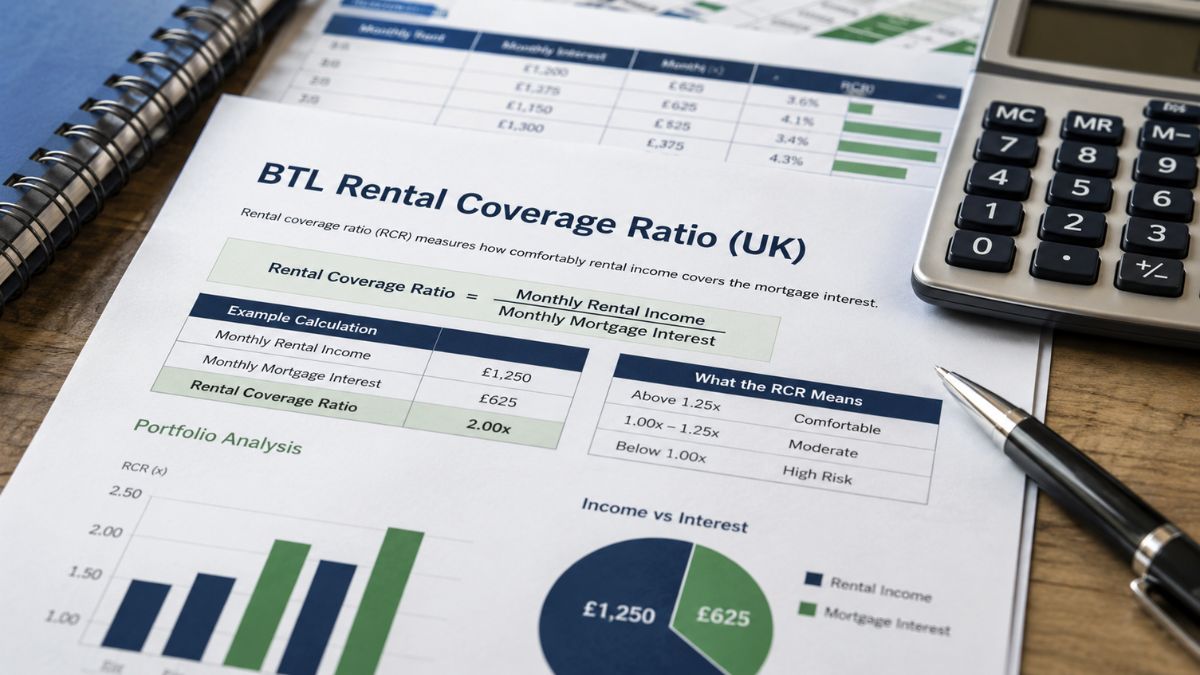
Buy to let stress test UK - how the calculation works
Lenders apply two components together. The ICR (Interest Coverage Ratio) sets how far rent must exceed the mortgage interest - the btl rental coverage ratio UK lenders require is typically 125% for basic-rate taxpayers and limited companies, and 145% for higher-rate taxpayers, reflecting the tax each keeps from the rent. The stress rate is the notional interest rate the test is run at - under PRA rules, at least 2% above the product pay rate with a 5.5% floor for most products, though 5-year fixed rates may be tested at the actual pay rate.
The maximum loan formula is: annual rent ÷ ICR ÷ stress rate. The icr calculation buy to let UK lenders run is identical across the market - only the ICR percentage and stress rate vary by lender and product.
Worked example - the same property, three different loans
Property renting at £1,200 per month (£14,400 per year):
- Higher-rate taxpayer, 2-year fix tested at 5.5%: £14,400 ÷ 1.45 ÷ 0.055 = £180,564 maximum loan
- Limited company, 2-year fix tested at 5.5%: £14,400 ÷ 1.25 ÷ 0.055 = £209,454 maximum loan
- Limited company, 5-year fix tested at 4.5% pay rate: £14,400 ÷ 1.25 ÷ 0.045 = £256,000 maximum loan
Same property, same rent - a £75,000 difference in borrowing purely from structure and product choice. This is why understanding the buy to let affordability rules UK lenders apply is worth real money.
Buy to let affordability rules UK - what else lenders check
Buy to let affordability rules UK lenders apply extend beyond the headline ICR. The full assessment in 2026 covers the borrower as well as the property.
Alongside the stress test, lenders assess:
- Minimum personal income - many lenders require £25,000; several have no minimum
- Personal affordability - your own commitments must not rely on the rental surplus
- Portfolio landlords (4+ properties) - whole-portfolio ICR and business plan under PRA rules
- Top-slicing - some lenders let surplus personal income make up an ICR shortfall
- Property type - HMOs and holiday lets are tested on their specific rental profiles

Buy to let affordability rules UK cover minimum income, personal commitments, portfolio-level tests, and top-slicing - Money Pilot matches your profile to the lenders whose rules fit.
Seven ways to pass the stress test at the level you need
- 1. Choose a 5-year fixed product - tested at pay rate rather than pay rate +2%, immediately lifting the maximum loan
- 2. Buy through a limited company - 125% ICR instead of 145% for higher-rate taxpayers; see our full guide to limited company buy to let UK
- 3. Use top-slicing lenders - surplus personal income can bridge an ICR gap with the right lender
- 4. Evidence the true market rent - an ARLA letting appraisal supporting a higher rent moves the whole calculation
- 5. Reduce the loan, not the deal - a slightly larger deposit often unlocks a cheaper rate band and a gentler stress
- 6. Match the lender to the property - HMO specialists stress on room-by-room income; holiday-let lenders on seasonal averages
- 7. Compare the whole market - ICRs, stress rates, floors, and top-slicing policies differ lender to lender far more than rates do
Portfolio landlords - the additional layer
With four or more mortgaged buy to lets, PRA rules require lenders to assess the whole portfolio, not just the new purchase: aggregate ICR across every property, a schedule of the portfolio, and often a business plan and cash flow. Individual weak properties can be carried by strong ones, but the portfolio as a whole must pass. Specialist portfolio finance lenders run this assessment daily and apply far more pragmatic criteria than mainstream banks.
What changes in practice for 2026
Stress testing has stabilized: with base rate settled, most lenders test 2-year products at 5.5%–6.5% and 5-year fixes at pay rates in the 4s. The practical consequence is that 5-year fixed products now dominate new BTL lending - not for rate security alone, but because they simply allow landlords to borrow what the deal needs. Structure and product selection have become as important as the deposit.
Common stress test mistakes to avoid
- Testing your own sums at the pay rate - lenders test at the stressed rate; deals that work at 4.5% can fail at 5.5%
- Using optimistic rent figures - the valuer’s rental figure, not the asking rent, drives the calculation
- Ignoring the ICR jump on remortgage - moving from a company back to personal names, or from basic to higher rate, tightens the test
- Applying to one lender - a marginal fail with one lender is a comfortable pass with another
Disclosure: Money Pilot Ltd (FRN: 968705) is an Appointed Representative of Yellow Stone Finance Group Ltd which is authorised and regulated by the Financial Conduct Authority (FRN: 814533). Yellow Stone Finance Group Ltd is a credit broker not a lender. Money Pilot Ltd is Registered in England and Wales No: 13621432. You should always make sure you are able to afford any repayments as late or missed payments can affect your credit rating and access to future finance.
YOUR PROPERTY MAY BE REPOSSESSED IF YOU DO NOT KEEP UP REPAYMENTS ON A MORTGAGE OR ANY OTHER DEBT SECURED ON IT.