✅ Is an employee ownership trust better than a trade sale?
Neither wins universally - they trade different things. The EOT: 0% CGT on selling a controlling stake (more than 50%) to a qualifying trust, legacy and culture preserved, no buyer-hunt - paid for with deferred consideration funded largely from the company’s own future profits, so the vendor carries ongoing performance risk. The trade sale: competitive tension, potentially a strategic premium, and cash at completion - taxed at BADR 18% (from April 2026) on the first £1m lifetime and 24% above, with earnouts and integration risk in the mix. Owner priorities decide. Money Pilot funds both routes - 200+ lenders, zero broker fees, FCA regulated (FRN: 968705).
The employee ownership trust vs trade sale question has moved from succession-planning seminars to kitchen tables, and tax did the moving: while capital gains rates on conventional exits have climbed - Business Asset Disposal Relief reaching 18% from April 2026 - a qualifying EOT sale still runs at 0% CGT. That headline hides a genuinely different transaction underneath: who pays you, when, from what, and with how much risk. Here is the comparison owners actually need - tax, money, control and fit.
Bank of England held base rate at 4.25% in June 2026 - waiting for inflation to cool.
73% of UK SMEs expect to grow in the next 12 months - confidence remains strong.
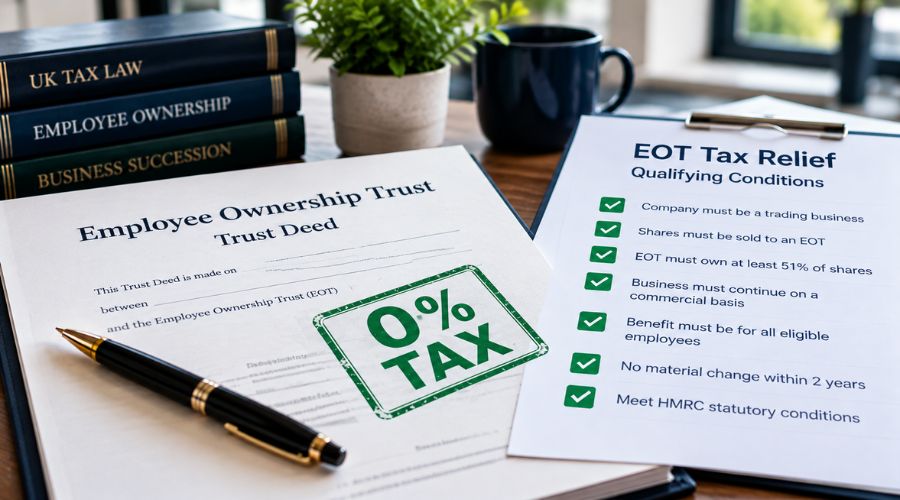
EOT tax relief rules UK - what 0% actually requires
The eot tax relief rules uk are generous precisely because they are conditional. The core tests: the trust must acquire and keep a controlling interest (over 50%) in a trading company; the benefit must run to all eligible employees on equal terms; and since the autumn 2024 reforms the regime tightened sensibly - former owners cannot control the trust post-sale, trustees must be UK resident, the sale price must be supported by independent valuation, and the clawback window (where disqualifying events unwind the vendor’s relief) now stretches to the end of the fourth tax year after sale. The employee sweetener continues: income-tax-free bonuses of up to £3,600 per employee per year under EOT ownership. The honest translation: 0% is real, but it is earned by structure and held by behaviour - an EOT bent around tax avoidance rather than genuine employee ownership is exactly what the reforms were built to catch.
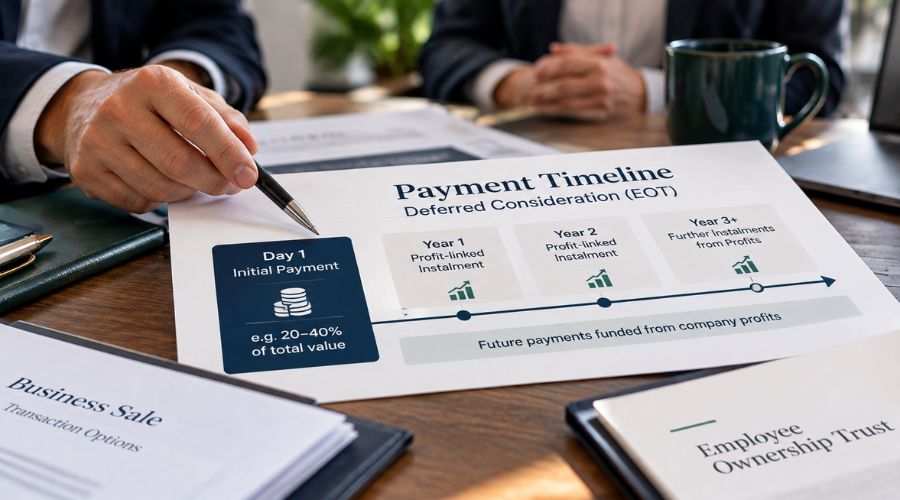
EOT funding structure UK - where your money actually comes from
The eot funding structure uk is the part glossy seminars underplay: the trust has no money. A typical structure pays the vendor a modest day-one amount - from company cash reserves and sometimes an external debt layer - with the majority as deferred consideration: loan notes repaid over, commonly, 5–8 years from the company’s future post-tax profits. Which makes three numbers decisive: sustainable profits (the repayment engine), the day-one percentage (external funding can lift it - lenders increasingly write EOT transactions against company cash flows), and the interest and protections on your loan notes. Vendor risk is the mirror image: you have sold control of the company whose performance now pays you. Sensible mitigants - conservative valuation, covenants, security where negotiable, staged board transition - are deal design, and exactly where experienced advisers and funding structure earn their fees.
Trade sale vs EOT - the decision grid
Sell company to employees uk or sell to the market: the grid that actually decides it.
Line by line:
- Tax - EOT: 0% CGT on a qualifying sale. Trade sale: BADR 18% (from April 2026) on the first £1m lifetime, 24% main rate above - the gap widened again this April
- Cash timing - trade sale: most value at completion (earnouts aside). EOT: modest day one, the rest over years from company profits
- Price - trade sale: competitive tension can find a strategic premium. EOT: independent market value, honestly - no bidding war
- Risk after signing - trade sale: largely transferred (watch earnout terms). EOT: retained - your loan notes ride the company’s next five years
- Legacy & people - EOT: company stays independent, culture and jobs preserved, bonuses flow tax-free. Trade sale: integration, synergies, and the buyer’s plans
- Process - EOT: no buyer search, confidential, weeks-to-months. Trade sale: marketing, diligence, and the deal-fatigue months
Sell company to employees UK - who the EOT genuinely fits
Sell company to employees uk works best for a recognisable owner: profitable, cash-generative business; a management layer that can genuinely run it; an owner who values legacy, staff and locality alongside price, and who can afford patience on proceeds. It fits badly where profits are thin or lumpy (the repayment engine stalls), where the owner is the business, or where a strategic buyer would pay a premium the vendor needs. And the hybrid truth: some owners run a quiet twin-track - EOT feasibility priced alongside soft trade-sale soundings - before committing; our exit planning guide covers that sequencing against the April tax clock, and the MBO route remains the third door where a management team wants real equity rather than trust ownership.
Funding either exit - where Money Pilot sits
Both routes complete faster with finance engineered early. For EOTs: external debt layered against company cash flows to lift the vendor’s day-one payment and de-risk the notes. For trade sales and MBOs: acquisition funding for the buyer - which sellers should care about, since a funded buyer is a completing buyer. Money Pilot structures both across 200+ lenders at zero broker fees, alongside your accountant and lawyers who own the tax and trust mechanics. Call 020 4634 8617 before the structure is fixed - funding options narrow once heads of terms are signed. FCA regulated (FRN: 968705).