✅ How does a base rate change affect property finance?
Through two different doors. Variable and tracker products move almost mechanically - a 0.25% cut flows into the pay rate within a billing cycle. Fixed rates barely notice the announcement itself: they price off swap rates, which move on expectations, so an anticipated cut is in fixed pricing weeks before the MPC votes and a “surprise hold” can push fixes up on cut day. With base at 3.75% in late 2026, the borrower’s skill is matching product to plan rather than forecasting the committee. Money Pilot prices both paths across 200+ lenders - zero broker fees, FCA regulated (FRN: 968705).
The bank of england base rate property impact gets re-explained badly eight times a year - every MPC decision day produces headlines implying one number moves every mortgage in Britain the same way. It doesn’t, and the borrowers who understand which door their product sits behind make consistently better timing decisions. This is the standing explainer: the mechanics, the current position, and the decision framework - refreshed as the cycle moves.
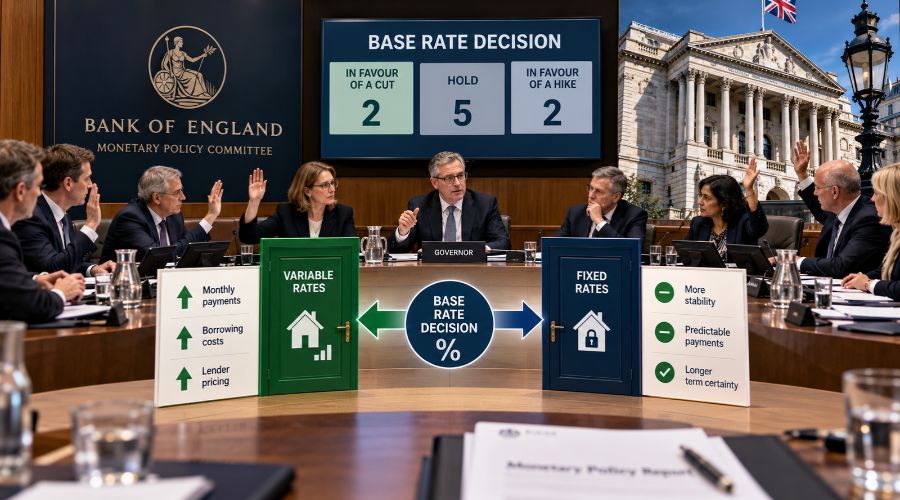
Bank of England held base rate at 4.25% in June 2026 — waiting for inflation to cool.

73% of UK SMEs expect to grow in the next 12 months — confidence remains strong.
MPC decision borrowing effect - the mechanics in plain terms
The mpc decision borrowing effect runs on a simple split. The Monetary Policy Committee meets eight times a year and sets Bank Rate - held at 3.75% as of late October 2026 after the cutting cycle’s pause. From there:
- Trackers - contractually base-plus-margin: the decision passes through in full, usually from the next payment
- Lender variable rates (SVRs, discounted variables) - move at the lender’s discretion: cuts arrive partially and slowly, rises arrive promptly - asymmetry borrowers should price
- Fixed rates - priced off swap markets, not the announcement: the full mechanics live in our swap rates guide
- Stress tests - the quieter effect: lender affordability and ICR stress rates ease as the rate outlook falls, moving how much you can borrow, not just its price (BTL stress testing explained)
- Development & bridging - short-term money prices off near-term rate expectations plus risk: the base-rate story matters less than lender appetite
Base rate cut mortgage pricing - why fixes don’t wait for the vote
Base rate cut mortgage pricing disappoints borrowers in one specific, predictable way: the cut arrives and fixed rates barely move - because markets priced the cut into swaps weeks earlier. The corollaries worth internalising: fixed rates can fall before any cut (expectations building), can rise on cut day (if guidance turns hawkish), and the gap between base at 3.75% and the best fixes reflects where markets think base is going, not where it sits. Practical consequences: waiting for the next MPC date before securing a deal is usually theatre - the information is already in the price; product-switch windows (most lenders allow re-selection before completion) are the real option value; and our rate outlook guide tracks where the forecasting consensus actually stands.
Variable vs fixed after cuts - the decision framework
Variable vs fixed after cuts is the live question of the 2026/27 cycle - base paused at 3.75%, markets debating the next move’s direction and timing.
How to decide like a professional:
- Match the product to the plan, not the forecast - selling or refinancing inside two years points to trackers or short fixes without ERCs; holding long-term makes today’s five-year money a budgeting decision, not a bet
- Price the asymmetry - on a variable you win every cut and lose every surprise; ask which error your cash flow survives better
- Count the already-priced cuts - if fixes assume two more cuts and only one comes, the variable borrower loses the race they thought they were winning
- Use the hybrid tools - dual-rate structures, ERC-light products and switch windows exist precisely for undecided cycles
- Portfolio view beats product view - landlords with several loans can ladder maturities so no single MPC year reprices everything at once (remortgage sequencing guide)
Reading decision day itself - the borrower’s 10 minutes
When the decision lands, three things deserve your ten minutes: the vote split (7–2 says more conviction than 5-4 - markets re-price the next meeting on it), the guidance language (“gradual and careful” vs anything firmer moves swaps more than the decision), and the inflation commentary (services inflation and wage growth are the committee’s stated obsessions; their trajectory is the cut path). What doesn’t deserve your time: headlines converting a hold into drama. A hold at 3.75% with dovish guidance can cut your next fix; a cut with hawkish guidance can raise it.
What this means for 2026/27 borrowing - and where we fit
The strategic read on the current cycle: money is meaningfully cheaper than the 2023/24 peak, the refinance wave is repricing old cheap debt upward and recent expensive debt downward simultaneously, and the winners are borrowers who treat rate decisions as inputs - secured products with switch flexibility, maturities laddered, stress-test headroom banked. Money Pilot’s desk watches pricing across 200+ lenders daily: tracker margins, fix pricing against the swap curve, and which lenders pass cuts through fastest. Call 020 4634 8617 before the next decision, not after it - by then, you’re reading yesterday’s price. FCA regulated (FRN: 968705).