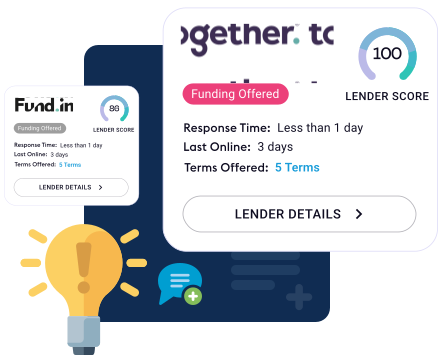
Money Pilot reduces uncertainty in domestic and cross-border trade. We match you with providers for letters of credit, SCF, and structured solutions, then coordinate documents end-to-end.
Clear terms and fast responses help you trade with confidence.
Funding that supports cross-border trade by bridging payment timing gaps.
Importers, exporters, and manufacturers trading internationally.
Letters of credit, bank guarantees, and invoice finance.
Yes — trade finance minimises payment and delivery risk.
Yes, suitable for both SMEs and large corporations.
No hidden fees — all costs are disclosed upfront.
Most specialist trade finance providers have minimum transaction sizes of £50,000 to £100,000. Below these thresholds, the cost of the letter of credit or trade loan structure is disproportionate to the transaction value, and a simpler product such as a short term business loan or revolving credit facility may be more appropriate. For larger transactions of £500,000 or more, specialist commodity finance providers and trade banks offer more competitive terms. Money Pilot advises on the right product for your specific transaction size.
A letter of credit is a commitment from the buyer's bank to pay the seller a specified amount once the seller presents documents proving the goods have been shipped as agreed. It is used when the buyer and seller do not have an established relationship, when the goods are of high value, or when the seller's country presents payment risk. Letters of credit are the most secure form of payment for international trade but also the most complex and costly to arrange. Simpler instruments such as documentary collections are appropriate for established trading relationships with lower risk counterparties.
A straightforward import trade loan can be arranged within 3 to 5 working days for an established UK importer with a clean credit profile and a well-documented transaction. A letter of credit typically takes 5 to 10 working days to issue. More complex structured transactions involving multiple banks, multiple jurisdictions, or commodity finance take 2 to 4 weeks. Having the transaction documentation (purchase contract, pro forma invoice, shipping terms) ready before approaching a provider significantly speeds up the process.
Trade finance is generally more accessible to businesses with an established trading history and existing supplier or customer relationships. However, some specialist trade finance providers will consider early-stage businesses for specific transactions where the goods are of high quality, the counterparty is creditworthy, and the structure of the transaction provides adequate security. A letter of credit is sometimes more accessible for a new business than an unsecured trade loan, as the bank's risk is secured against the shipping documents rather than the business's credit profile.
Trade finance primarily addresses the payment risk and working capital gap in international trade — particularly the gap between buying from overseas suppliers and selling to UK customers. Supply chain finance (reverse factoring) is primarily a domestic tool that allows buyers to extend supplier payment terms while giving suppliers early payment through a third-party finance provider. Trade finance is transaction-specific and cross-border; supply chain finance is programme-based and typically domestic. Both address working capital, but in different trade contexts.
Money Pilot compares trade finance from specialist UK banks and non-bank trade finance providers — matching your transaction type, goods, counterparty countries, and tenor to the most appropriate product and provider. We compare letters of credit, import trade loans, export invoice discounting, and structured commodity finance. We also compare supply chain finance for domestic supply chains. Zero broker fees. FCA regulated (FRN: 968705). Call 020 4634 8617.
✅ What is trade finance and how does it work for UK importers and exporters?
Trade finance covers specialist financial products that enable UK businesses to buy from overseas suppliers or sell to overseas customers by bridging the payment and delivery gap in international trade. Key products include letters of credit, documentary collections, trade loans, and structured commodity finance. Money Pilot compares trade finance from specialist UK providers - FCA regulated (FRN: 968705), zero broker fees.
How trade finance works for UK businesses
International trade creates a fundamental tension between buyers and sellers - the buyer wants to receive the goods before paying, while the seller wants to receive payment before dispatching the goods. Trade finance resolves this tension by using financial instruments that provide security to both parties simultaneously, allowing international trade to happen at scale between businesses that may have little prior relationship.
Bank of England held base rate at 4.25% in June 2026 - waiting for inflation to cool.
73% of UK SMEs expect to grow in the next 12 months - confidence remains strong.
Core trade finance products for UK businesses
Letter of credit (LC) - the buyer's bank guarantees payment to the seller once the seller presents specified shipping documents. The seller ships with payment certainty; the buyer pays only once documents confirm shipment. The most widely used trade finance instrument globally
Trade loans and import finance - a short-term loan (typically 30 to 180 days) that funds the purchase of goods from overseas suppliers. The loan is repaid when the goods are sold to UK customers. Allows the importer to buy goods without depleting working capital
Invoice discounting for exporters - releasing cash against overseas invoices before the foreign buyer pays. Particularly valuable for exporters offering extended credit terms to overseas customers
Structured commodity finance - specialist financing for businesses importing or trading commodities - metals, agricultural products, energy - secured against the physical commodity or its value. Compare also supply chain finance for domestic supply chains
Money Pilot compares trade finance from specialist UK banks and non-bank lenders at zero broker fees. FCA regulated (FRN: 968705).
What trade finance providers assess
Trade finance providers assess the specific transaction as much as the business itself. Understanding their criteria helps UK importers and exporters structure transactions to access the most competitive terms.
Key trade finance assessment criteria:
Buyer and seller credit quality - the creditworthiness of both counterparties; strong buyers and sellers in established relationships attract better terms
Country risk - the political and economic stability of the countries involved; some markets require specialist trade finance instruments
Commodity or goods type - the nature of the goods being traded; essential commodities attract broader lender appetite than niche or perishable goods
Transaction size and tenor - minimum transaction sizes typically £50,000; terms of 30 to 360 days depending on the product and goods
Trading history - established import/export relationships with documented track record support faster approval and better pricing
Trade finance bridges the payment and delivery gap in international trade - providing security to both buyer and seller simultaneously. Compare specialist UK trade finance providers at Money Pilot.
Trade finance - four common scenarios for UK importers and exporters
These four scenarios illustrate how trade finance resolves the most common challenges UK businesses face when buying from overseas suppliers or selling to overseas customers.
A new overseas supplier relationship typically requires the importer to pay upfront before the goods are dispatched — exposing the buyer to risk if the supplier fails to deliver. A letter of credit addresses this directly. The importer's bank issues an LC in favour of the supplier, guaranteeing payment once the supplier presents shipping documents confirming the goods have been dispatched as agreed. The supplier ships with payment certainty; the importer pays only once the bank confirms the documents are compliant. A trade loan can fund the LC payment once the goods are en route, with repayment from the UK sale proceeds.
A retailer importing seasonal stock — Christmas goods, summer clothing, or back-to-school products — must pay overseas suppliers months before the stock is sold. An import trade loan funds the purchase from the overseas supplier, with repayment from the UK retail revenue when the goods are sold. The trade loan term (typically 90 to 180 days) aligns with the time between payment to the supplier and receipt of retail revenue. This allows the importer to place the full seasonal order without depleting working capital that is needed for other operational costs during the pre-season period.
UK exporters offering 60 or 90 day credit terms to overseas customers face a cash flow gap between dispatching goods and receiving payment. Export invoice discounting allows the exporter to release 80 to 90% of the invoice value from a specialist provider immediately after dispatch, with the balance released when the overseas buyer pays on the due date. This eliminates the cash flow impact of extended overseas credit terms and allows the exporter to compete on payment terms with international competitors without constraining their own working capital.
International trade creates currency exposure — an importer contracted to pay a supplier in US dollars in 90 days faces the risk that sterling weakens significantly before the payment date, increasing the sterling cost of the purchase. Trade finance providers offer forward contracts and structured currency products alongside the underlying trade finance instrument, locking in the exchange rate at the point of contract rather than at the point of payment. Money Pilot's trade finance specialists advise on managing currency risk alongside the appropriate trade finance structure for each transaction.
Bank of England held base rate at 4.25% in June 2026 - waiting for inflation to cool.
73% of UK SMEs expect to grow in the next 12 months - confidence remains strong.
Trade finance routes - bank desk vs whole market
Bank trade desks serve their existing customers with their own products. The independent trade finance market - specialist funders, fintech platforms, and UKEF-backed structures - frequently funds the transactions banks decline, and prices the ones they don't.
What matters
Your bank's trade desk
Money Pilot
Access
Existing bank customers, strong balance sheets
Transaction-led: the deal's strength can carry a younger business
Specialists underwrite the order and the counterparty, not just your accounts
Government support
Rarely surfaced
UKEF routes identified where they strengthen the deal
Broker fee
-
£0 - zero broker fees
Fund the cycle, not the gap - how traders structure it
Trading businesses do not have one funding gap; they have a repeating cycle - pay the supplier, ship, land, sell, collect - and each stage has a tool built for it. Import and purchase-order facilities pay the supplier against confirmed orders; letters of credit or collections carry the shipment-stage risk between strangers; stock facilities hold the goods while they sell; and export factoring or invoice finance turns the final invoice into cash within 24–48 hours. Funded as one connected structure, the cycle finances itself and scales with order volume.
Two things separate well-funded traders from strained ones: matching each tool to its stage rather than stretching one facility across the whole cycle, and using payment security (LCs, credit insurance, UKEF backing) deliberately where counterparty risk is real rather than everywhere or nowhere. We map your specific cycle - countries, terms, counterparties, volumes - and assemble the structure across the market.
The zero-fee promise
Most UK brokers charge 1–1.5% of the loan as their fee. Money Pilot charges zero broker fees - we are paid by the lender, our whole-of-market comparison across 200+ specialist UK lenders stays free to you, and Miranda Khadr’s team is directly FCA regulated (FRN: 968705).
Unit 1, Verney House 1B Hollywood Road, London SW10 9HS
Opening Times: 9am - 6pm, Mon - Fri
Company Registration No. 13621432
We use cookies to improve your experience, provide live support, and analyse site traffic. By clicking "Accept All", you consent to our use of cookies.
Cookie Preferences
Select which cookies you want to accept. Essential cookies cannot be disabled.
Required for the website to function securely and save your preferences.
Enables our live chat support (HubSpot) and remembers your session state.
Allows us to measure traffic and see how visitors use the site via Google Analytics.
Used to deliver and track personalized advertisements via Google Ads and Meta.