Money Pilot helps buyers, landlords, and developers secure quick bridging loans to purchase, refinance, or complete property transactions.
We connect you with trusted UK lenders competing to fund your short-term goals.
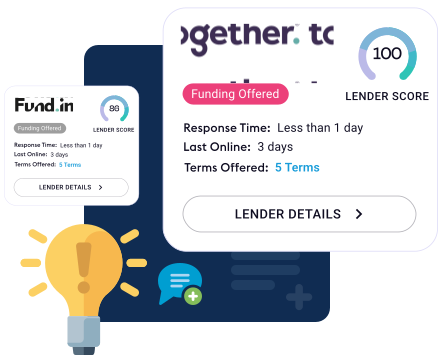
Complete a fast but in-depth overview of your finance requirements to allow our powerful matching engine to source the right lenders for you.
Engage directly with lenders in real-time, with our friendly advisors always on hand to guide you through every step of the funding journey.
Track your enquiry in real-time and seamlessly move to application— all in one place—getting you to your funds faster and with less hassle.
At Money Pilot, we’ve reimagined bridging finance for time-critical property moves. Our system matches borrowers instantly with lenders who understand auction deadlines, chain breaks, and rapid completions.
From valuation to exit, we provide clear terms, fast decisions, and hands-on support so your deal never stalls.
Money Pilot instantly puts your enquiry in front of hundreds of specialist lenders who are ready to match your loan criteria, for:
✅ What is bridging finance and how does it work in the UK?
Bridging finance is a short-term secured loan that bridges the gap between a property purchase and a longer-term funding solution — completing in as few as 5 to 14 days. It is used for auction purchases, chain breaks, refurbishment, and unmortgageable properties. Money Pilot compares 200+ specialist UK bridging lenders — FCA regulated (FRN: 968705), zero broker fees.
Bridging finance is a secured short-term loan typically lasting 1 to 24 months. Unlike a mortgage, bridging finance is assessed primarily on the security — the property being used as collateral — and the exit strategy, rather than on income and employment status. This makes it accessible to a far wider range of borrowers than standard mortgage products.
Bank of England held base rate at 4.25% in June 2026 — waiting for inflation to cool.
73% of UK SMEs expect to grow in the next 12 months — confidence remains strong.
UK bridging finance rates typically range from 0.55% to 1.5% per month depending on the lender, LTV, and security. Terms range from 1 to 24 months. Interest can be rolled up (no monthly payments — repaid at exit), retained (deducted upfront), or serviced (paid monthly). Most lenders offer up to 75% LTV for residential bridging and 65% to 70% for commercial security.
Money Pilot compares specialist bridging finance and commercial bridging finance lenders across the full UK market at zero broker fees. FCA regulated (FRN: 968705).
Specialist bridging lenders use manual underwriting, assessing each case on the strength of the security and the credibility of the exit strategy rather than applying rigid automated criteria.
Key bridging lender assessment criteria:
Bridging finance completes in 5 to 14 days — far faster than any mortgage. Money Pilot compares 200+ specialist UK bridging lenders at zero broker fees.
Whether you are a first-time bridging borrower or an experienced property investor, these four elements determine whether your bridging loan will complete on time and on the terms you expect.
UK bridging loans are classified as either regulated or unregulated. A regulated bridging loan is secured on a property the borrower or a close family member currently lives in or intends to live in — governed by FCA rules and requiring appropriate advice. Unregulated bridging loans cover all other cases including investment properties, commercial property, development security, and land. Most property investor and developer bridging loans are unregulated. Money Pilot is FCA regulated (FRN: 968705) and can advise on both.
A closed bridging loan has a fixed repayment date — typically because contracts have been exchanged on a property sale that will provide the exit funds. A closed bridge carries less lender risk and typically attracts a lower rate. An open bridging loan has no fixed repayment date within the agreed term — the borrower repays when the exit event occurs. Open bridges are more flexible but typically slightly more expensive to reflect the additional lender risk.
Every bridging loan must have a clearly defined and credible exit strategy before a lender will commit. The two most common exits are sale of the property and refinance onto a long-term mortgage. For sale exits, agent valuations and comparable evidence strengthen the case. For refinance exits, a mortgage in principle from an appropriate lender before the bridge is taken is the most robust approach. Lenders assess exit credibility very carefully — a weak or speculative exit is the most common reason for declining.
A re-trade occurs when a bridging lender changes the terms of the loan — reducing the loan amount, increasing the rate, or adding conditions — close to the point of completion. Re-trades waste legal costs already incurred and can jeopardise purchase deadlines. Using a broker with strong lender relationships and current knowledge of which lenders have a reputation for delivering on original terms is the most effective way to avoid this risk. Money Pilot has direct relationships with all major specialist bridging lenders.
Bank of England held base rate at 4.25% in June 2026 — waiting for inflation to cool.
73% of UK SMEs expect to grow in the next 12 months — confidence remains strong.
The fastest UK bridging loans complete in 5 to 10 working days for straightforward cases. Most complete within 3 to 4 weeks. Speed depends on the complexity of the security, clarity of the exit strategy, and how quickly solicitors and valuers can act. Money Pilot identifies the lenders moving fastest at the time of your application.
Most UK bridging lenders offer up to 75% LTV for residential security and 65 to 70% for commercial property. Some specialist lenders will consider up to 80% where additional security is available. The best rates are typically at lower LTV positions. Money Pilot compares LTV appetite across 200+ specialist lenders.
Yes — specialist bridging lenders assess the security and exit strategy rather than credit history as the primary underwriting factor. Adverse credit including CCJs, defaults, and missed payments does not automatically preclude a bridging loan. The rate may be higher to reflect additional risk, but a well-structured case with strong security and a credible exit is fundable. Money Pilot identifies lenders with appetite for adverse credit cases.
Yes — bridging finance is the most common funding method for auction purchases in the UK. Auction conditions typically require completion within 28 days. Standard mortgages cannot meet this deadline; bridging lenders can. Money Pilot arranges an agreement in principle before the auction so you have funding confidence before bidding. Zero broker fees. FCA regulated (FRN: 968705).
A first charge bridging loan is secured as the only loan against the property — the lender has the primary legal charge. A second charge bridging loan sits behind an existing mortgage or loan on the same property — the bridging lender takes a second legal charge. Second charge bridging is used to raise capital from a property that already has a mortgage without disturbing the existing loan. Rates are typically slightly higher than first charge to reflect the additional risk.
Money Pilot compares bridging finance from 200+ specialist UK lenders — including MT Finance, Hope Capital, Octane Capital, West One Loans, and Tuscan Capital — matching your property, LTV, exit strategy, and timeline to the lender most suited to your case. Commercial bridging finance also available. Zero broker fees. FCA regulated (FRN: 968705). Call 020 4634 8617.
Disclosure: Money Pilot Ltd (FRN: 968705) is an Appointed Representative of Yellow Stone Finance Group Ltd which is authorised and regulated by the Financial Conduct Authority (FRN: 814533). Yellow Stone Finance Group Ltd is a credit broker not a lender. Money Pilot Ltd is Registered in England and Wales No: 13621432. You should always make sure you are able to afford any repayments as late or missed payments can affect your credit rating and access to future finance.
YOUR PROPERTY MAY BE REPOSSESSED IF YOU DO NOT KEEP UP REPAYMENTS ON A MORTGAGE OR ANY OTHER DEBT SECURED ON IT.